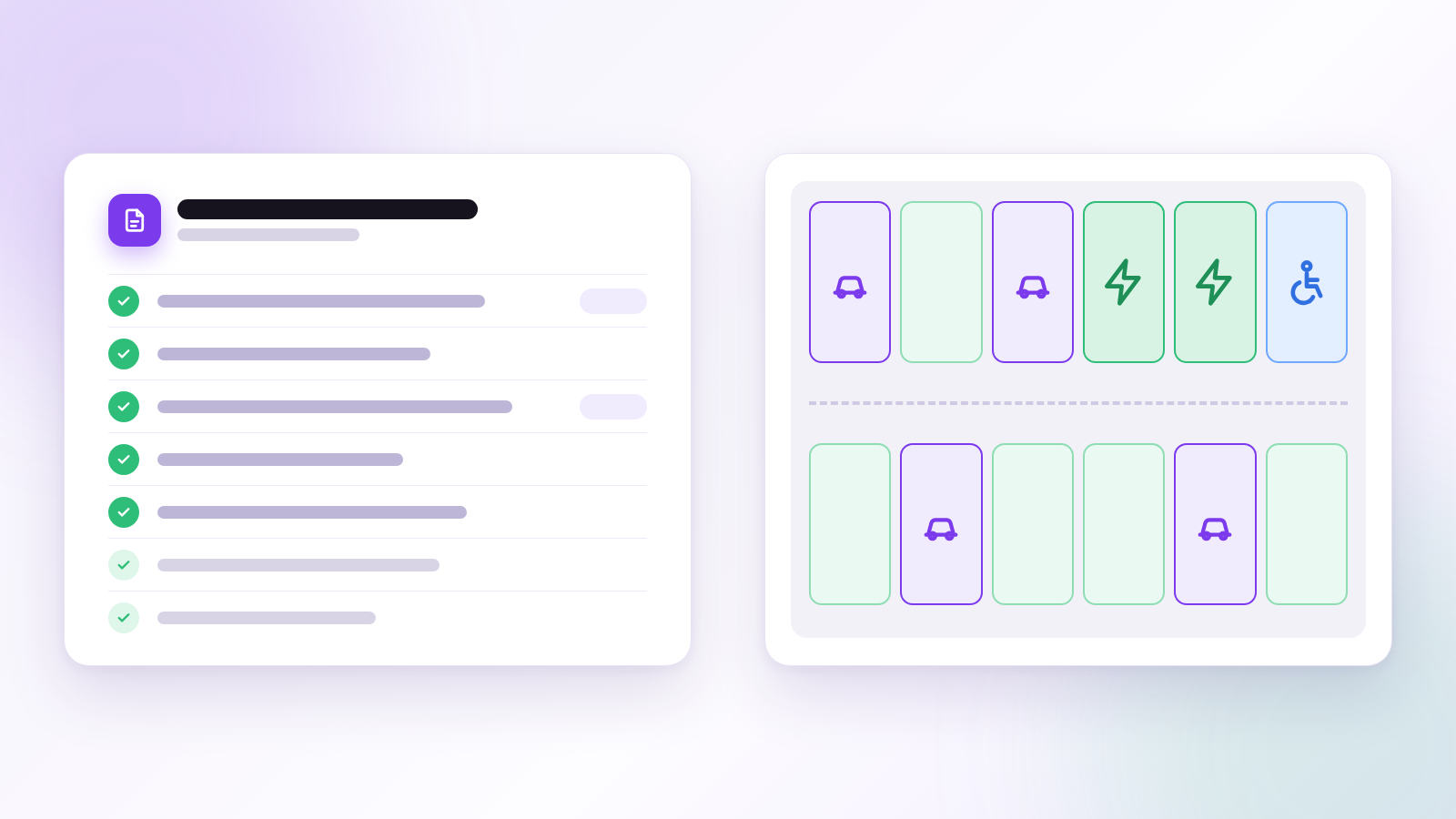
What a parking policy is and why you need one
It is the document that sets the rules of the company car park: who is entitled to a space, how spaces are shared out and what is expected of the people who use them. When it does not exist, the rules live in one person's head or in scattered messages, and every case is settled through exceptions.
Having it in writing brings three things:
- Visible fairness. Everyone knows why one person has a fixed space and another has to book.
- Less refereeing. Whoever manages the car park applies a rule, not an opinion.
- A base for change. If hybrid work or EV chargers change demand, you adjust the document instead of starting from scratch.
It does not need to be long. A clear page gets read and followed; a ten-page rulebook does not.
What it should include: the decisions to make
| What to decide | Common options |
|---|---|
| Who can park | All employees, only those who come by car with a registered plate, contractors and visitors with a booking. |
| How spaces are assigned | Fixed by need, daily booking, first come first served or a mixed model. |
| How to book | How many days ahead, until what time you can cancel and how many days per person. |
| Usage rules | Park only in the assigned or booked space, opening hours and use outside the working day. |
| Visitors | Spaces reserved for guests and who requests them. |
| EV chargers | Booking by time slot, maximum duration and a grace period to move the car. |
| Special spaces | Reduced mobility, service vehicles and any documented priority. |
| Issues | A channel to report faults, misuse or damage, and who responds. |
| Breaches | A warning, a reminder and, if repeated, a temporary suspension of the right to book. |
| Review | Every six months or when occupancy changes noticeably. |
Assignment criteria: the most debated decision
Almost all the debate centres on how spaces are shared out. There are three approaches, and none is the only one:
- By need. A fixed space for those with no reasonable alternative: reduced mobility, service vehicles or shifts outside public transport hours. It is the easiest criterion to defend.
- By booking. The remaining spaces are booked by the day with a booking window. It is fair and suits hybrid work.
- First come, first served. It works when there are more spaces than demand. If the car park fills up, it causes rushing and early arrivals.
The most common combination in mid-sized companies is a mixed model: a few fixed spaces on clear criteria and the rest on daily booking. Whatever you choose, write down the reason: a rule that is explained is accepted more easily.
A parking policy model (to copy and adapt)
Copy the text, replace what is in square brackets with your own values and delete anything you do not need:
Car park usage policy — [Company name]
- Purpose. To regulate the use of the [site] car park so that spaces are shared fairly and transparently.
- Who can use it. Employees who request it and have [their vehicle registered]. Visitors only with a prior booking by their host.
- Assignment. Fixed spaces for [reduced mobility, service vehicles…]. All other spaces are booked by the day.
- Bookings. They can be made up to [3] days ahead and cancelled until [8:00 on the same day]. When spaces are scarce, the limit is [X] days per person per week.
- Use of the space. Park only in the assigned or booked space and within [hours]. Do not leave the vehicle beyond [hours] without notice.
- EV chargers. They are booked in slots of [1 or 2] hours. When finished, the vehicle is moved within [15] minutes at most.
- Issues. Faults, misuse or damage are reported to [channel or person in charge].
- Data. Number plates are used only to manage the car park. [State who sees them and how long they are kept].
- Breaches. A first warning, a written reminder and, if repeated, a temporary suspension of the right to book for [X] weeks.
- Review. This policy is reviewed every [six] months and when occupancy changes noticeably.
Before approving it, discuss it with human resources and, where relevant, with employee representatives, especially the section on breaches.
How to communicate it so that it is followed
- Publish it where people will see it: the intranet, the car park noticeboard and the booking tool. An email that gets lost does not count.
- Explain the why of the criteria for fixed spaces, not just the what.
- Name someone in charge and a channel for questions and issues.
- Start with a trial period of a few weeks and adjust the rules with what happens.
- Measure real occupancy every month. Data settles more arguments than opinions.
- Review it regularly and communicate the changes.
Common mistakes when drafting the policy
- Making it too long. If nobody reads it, nobody follows it.
- Not explaining the criteria. A fixed space with no known reason causes resentment.
- Not deciding what happens when it is broken. A rule without consequences becomes a suggestion.
- Not planning for EV chargers. They cause the most conflict if left to first come, first served.
- Forgetting data protection. Number plates are personal data: say what they are used for and limit who has access to them.
- Writing it once and never reviewing it. Hybrid work and staffing changes alter demand.
How to apply it with LoomiSpot
LoomiSpot is office parking management software. This is what it covers of the policy:
- Fixed spaces and booking: you assign a space to a person on specific days, and the rest first come, first served.
- Booking window: you decide how many days ahead people can book.
- EV chargers by time slot, with a start time and a duration.
- A monthly calendar heatmap to see how many spaces are booked and how many are free each day, which lets you measure real occupancy.
- Issue reporting from the app: whoever spots a problem reports it and follows its status.
- Multiple offices, each with its own spaces and weekly schedule, and web, iOS and Android with the same interface for admins and employees.
The free plan allows up to 10 spaces and 15 users. LoomiSpot applies the booking rules; the consequences of a breach and the approval of the policy are up to your company.
Frequently asked questions
Is it mandatory for a company to have a parking policy?
In general no rule requires one, but having it in writing prevents conflicts and makes it easier to explain why each person does or does not have a space. If the policy affects working conditions, it is worth discussing it with human resources or your employment advisor.
What criteria can be used to assign parking spaces?
The most common are need (reduced mobility, service vehicles, no alternative transport), daily booking with a booking window and first come, first served. In mid-sized companies the usual approach is to combine a few fixed spaces based on need with daily booking for the rest.
How do you manage spaces for visitors?
A few specific spaces are reserved for guests and clients, and they are requested through the host. That way employees do not take them and visitors do not arrive with nowhere to park.
What should you do if someone breaks the parking rules?
The usual approach is a first warning, a written reminder and, if it is repeated, a temporary suspension of the right to book for a few weeks. Define the consequences in the policy and discuss them with human resources before applying them.
How often should the parking policy be reviewed?
As a guide, every six months and whenever occupancy changes noticeably, for example because of a new hybrid working model, more employees or the arrival of EV chargers.
Can you register employees' number plates?
Yes, but number plates are personal data. Use the information only to manage the car park, tell people what it is used for and how long it is kept, and limit who can see it.